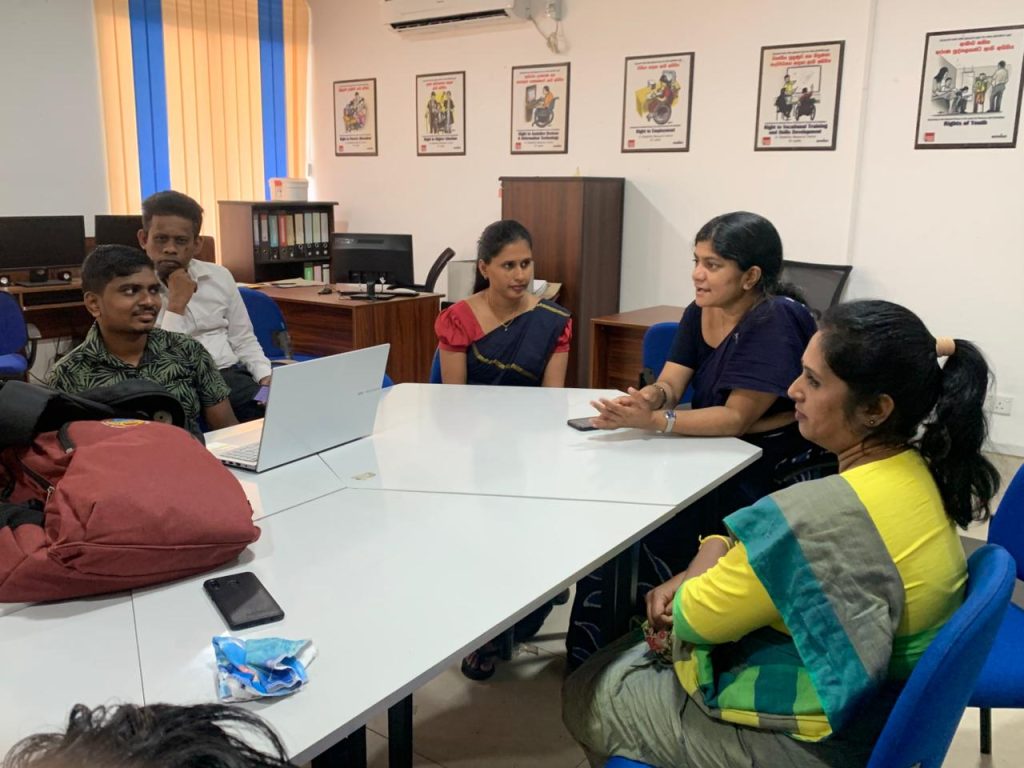

On 23rd January 2026, a visit was made to the Support Centre for Students with Disabilities (SCSD) at the University of Colombo to observe the facilities and support systems available for students with disabilities. The Centre plays a vital role in promoting inclusive education by providing assistive technologies, academic accommodation, digital accessibility, and personalized support.
The SCSD offers a wide range of assistive tools to mainly support visually impaired students. These include white canes for mobility, Braille writers for examinations, Braille slates for note-taking, DAISY players for audio learning, digital magnifiers for low-vision students, and refreshable Braille displays. Specialized devices such as magnetic tactile chessboards and Braille embossers are also available. Duxbury software is used for Braille translation in multiple languages, including Tamil, Sinhala, and English. These technologies enable students to access academic materials independently.
Examination support is well organized to ensure fairness. Students requiring assistance are granted 20 minutes of extra time per hour. Reading assistants are assigned for students with severe visual impairments. Low-vision students use magnifiers, while totally blind students complete examinations using Braille. The Centre maintains a database of student needs and coordinates with the Information and Documentation Center (IDC) to arrange appropriate accommodations.
Training and skill development are key services of the Centre. Students receive Braille literacy training, assistive device instruction, and adaptive ICT training. Visiting lecturers conduct sessions on assistive technologies such as Braille displays and audio description techniques. Workshops and practice sessions help students prepare lecture notes and examinations effectively.
Digital inclusion is strongly emphasized. Online courses are available in Tamil, Sinhala, and English with captions and audio descriptions. Screen readers such as JAWS and NVDA, along with OCR applications like Saththy, Envision AI, and Seeing AI, assist students in accessing digital content. Word documents are generally preferred over PDFs due to better accessibility. The buddy system further strengthens learning support, where volunteer students mentor differently-abled peers academically and socially.
The university also provides accessible infrastructure, including ramps, lifts, step-free pathways, Braille classroom numbering, and accessible hostel facilities with washrooms. Sports and extracurricular activities are encouraged, including blind cricket, chess, athletics, and swimming, promoting confidence and inclusion.
However, challenges remain in supporting students with multiple disabilities, particularly those with both visual and hearing impairments. Sign language programs are being introduced to improve accessibility. The Centre’s directors highlighted the need to identify the types of disabilities among prospective students and suggested focusing on students with low vision, physical impairments, and hearing impairments after consultation with relevant faculties.
Overall, the Support Centre for Students with Disabilities at the University of Colombo demonstrates a strong commitment to accessibility, equity, and inclusive higher education through comprehensive academic, technological, and social support systems.